qNEP: A highly efficient neuroevolution potential with dynamic charges for large-scale atomistic simulations
Z. Fan,
B. Tang,
E. Berger,
E. Berger,
E. Fransson,
K. Xu,
Z. Yan,
Z. Liu,
Z. Song,
H. Dong,
S. Chen,
L. Li,
Z. Wang,
Y. Zhu,
J. Wiktor,
and
P. Erhart
arXiv:2601.19034
doi: 10.48550/arXiv.2601.19034
zenodo: 18335946
(associated data)
Download PDF
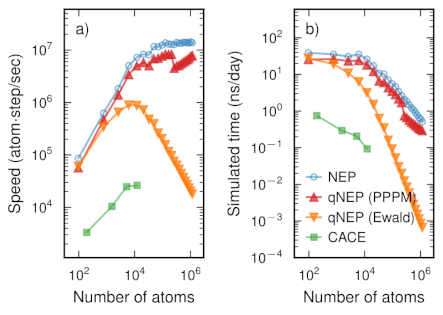
Although electrostatics can be incorporated into machine-learned interatomic potentials, existing approaches are computationally very demanding, limiting large-scale, long-time simulations of electrostatics-driven phenomena such as dielectric response, infrared activity, and field–matter coupling. Here, we extend the neuroevolution potential (NEP), a highly efficient machine-learned interatomic potential, to a charge-aware framework (qNEP) by introducing explicit, environment-dependent partial charges. Each ionic partial charge is represented by a neural network as a function of the local descriptor vector, analogous to the NEP site-energy model. This formulation enables the direct prediction of the Born effective charge tensor for each ion and, consequently, the polarization. As a result, dielectric properties, infrared spectra, and coupling to external electric fields can be evaluated within a unified framework. We derive consistent expressions for the forces and virials that explicitly account for the position dependence of the partial charges. The qNEP method has been implemented in the free-and-open-source GPUMD package, with support for both Ewald summation and particle– particle particle– mesh treatments of electrostatics. We demonstrate the accuracy and efficiency of the qNEP approach through representative applications to water, Li7La3Zr2O12, BaTiO3, and a magnesium– water interface. These results show that qNEP enables accurate atomistic simulations with explicit long-range electrostatics, scalable to million-atom systems on nanosecond time scales using consumer-grade GPUs.