Stability of Polarons and Oxygen Vacancies in BiVO4 Revealed by Machine-Learning-Driven Simulations
E. Berger,
T. Hainer,
T. Möslinger,
P. Erhart,
and
J. Wiktor
PRX Energy 5, 13828
(2026)
doi: 10.1103/xwxv-6s55
zenodo: 19369114
(associated data)
Download PDF
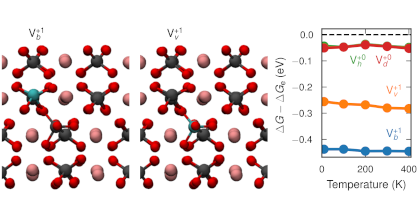
Bismuth vanadate is a promising photoanode material for photoelectrocatalytic water splitting. Localized charges play a crucial role in the water-splitting mechanism by introducing charge-transition levels within the band gap and thereby modifying the band alignment. Additionally, the introduction of oxygen vacancies, which can interact with electron polarons, has been reported to improve the photoelectrocatalytic efficiency. However, charge-transition levels are typically evaluated at 0 K, whereas operating conditions involve finite temperatures and, in thin films, epitaxial strain. Capturing these effects requires free energies and extensive sampling that are generally prohibitive for ab initio methods. In this work, we train a machine-learned interatomic potential for BiVO4, including electron polarons and oxygen vacancies in various charge states, to resolve how free energies, transition levels, and charge trapping evolve under operando temperature and strain conditions. For oxygen vacancies, the use of a machine-learned potential enables efficient sampling of charge-localization sites in the vicinity of the vacancy, revealing favored configurations. The energies of the localized polaron and oxygen-vacancy states remain essentially unchanged with temperature, while their transition levels relative to the band edges vary due to temperature-dependent band-edge shifts. In contrast, strain more strongly modifies both the localized states and the band edges. These results provide new insights into the stability of localized charges and their role in photoelectrocatalytic water splitting at finite temperature.