Bayesian Optimization for Practical H2 Sensors: Inverse Design of Pd-based Plasmonic Metasurfaces
P. Ekborg-Tanner,
A. Theodoridis,
J. Fritzsche,
C. Langhammer,
A. Baldi,
and
P. Erhart
arXiv:2608.18333
doi: 10.48550/arXiv.2608.18333
Download PDF
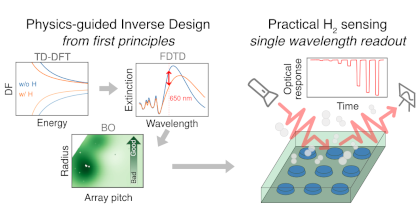
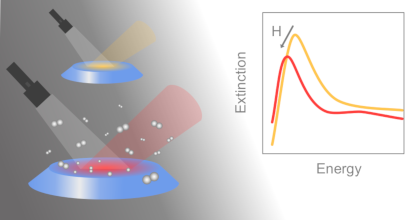
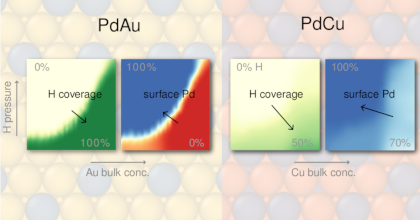
Hydrogen detection is becoming increasingly important as its use grows across energy and industrial systems. Optical sensing platforms based on palladium (Pd) nanoparticles are attractive for this task because hydrogen uptake directly alters their plasmonic response. Organizing such nanoparticles into periodic two-dimensional arrays, known as metasurfaces, further enhances their optical response through collective resonances. However, the large design space presented by chemical composition, nanoparticle geometry, and array structure calls for systematic approaches for optimizing complex nanoalloy metasurface geometries. Here, we develop an inverse-design framework based on Bayesian optimization that couples first-principles dielectric functions with electromagnetic simulations to identify high-performance PdAu nanodisk arrays for hydrogen sensing in the 1 to 100 mbar range where the flammability of H2 becomes a concern. We use our approach to search a five-dimensional design space, comprising nanodisk height and radius, array pitch, polymer coating thickness, and Au fraction in order to maximize the H-induced change in extinction at a single wavelength of choice. The results show that integrating first-principles optical models with data-efficient optimization yields experimentally feasible nanoparticle metasurfaces tailored for targeted hydrogen pressures, while providing a pathway to future multiobjective sensor design. They also reveal remaining gaps in the modeling methodologies that still limit the quantitative reliability of the approach.