Anion Ordering and Phase Stability Govern Optical Band Gaps in BaZrS3xSe3-3x
E. Fransson,
M. Xu,
P. Kayastha,
K. Ye,
I. Sadeghi,
R. Jaramillo,
J. M. LeBeau,
L. Whalley,
and
P. Erhart
Chemistry of Materials
(2026)
arXiv:2604.13768
doi: 10.1021/acs.chemmater.6c01949
Download PDF
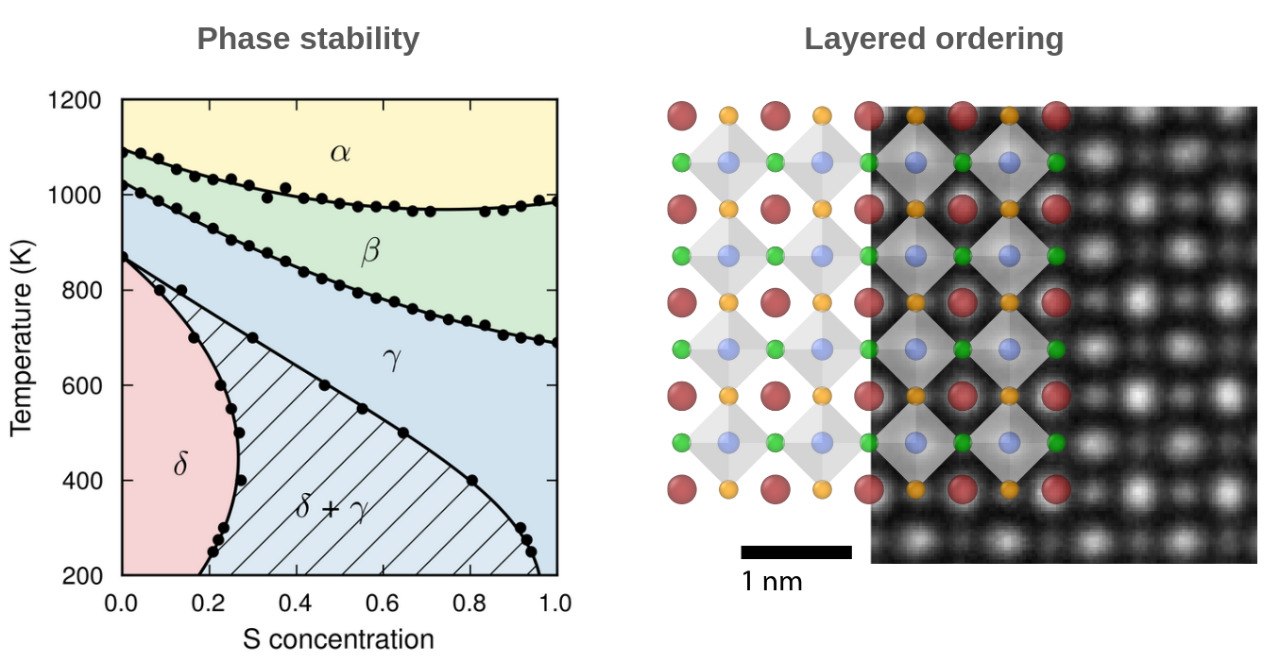
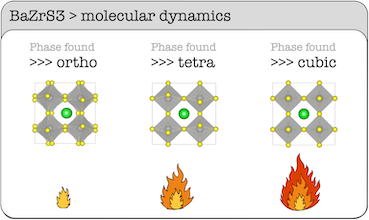
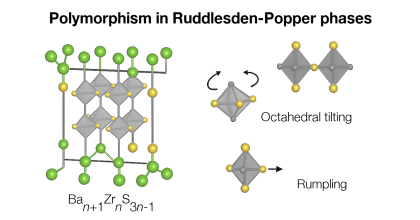
Chalcogenide perovskites have emerged as promising lead-free materials for photovoltaic and thermoelectric applications. Among them, BaZrS3 has attracted particular attention due to its thermal and chemical stability, favorable optoelectronic properties, and low thermal conductivity. Here, we combine molecular dynamics and Monte Carlo simulations based on a machine-learned interatomic potential with scanning transmission electron microscopy to investigate mixing thermodynamics and phase stability in the BaZrS3xSe3-3x system. We identify an unusual ordered structure that persists at room temperature, most prominently at 33% S, where S and Se atoms form alternating layers within the crystal. Free-energy calculations yield the temperature– composition phase diagram, including a non-perovskite δ phase in the Se-rich limit and a perovskite phase in the S-rich limit, separated by a broad two-phase region. Analysis of the dielectric function and the absorption coefficient demonstrates that composition, crystal structure, and anion ordering jointly control the optical band gap. Selenium alloying enables tuning between approximately 1.6 and 1.9 eV, while anion ordering within a given composition reduces the gap by about 0.12 eV. Lastly, variations between structural polymorphs give rise to band gap differences of up to 0.4 eV.