Efficient method for calculation of low-temperature phase boundaries
L. Svensson,
B. Sadigh,
C. Wu,
and
P. Erhart
arXiv:2603.08027
zenodo: 14925353
(associated data)
Download PDF
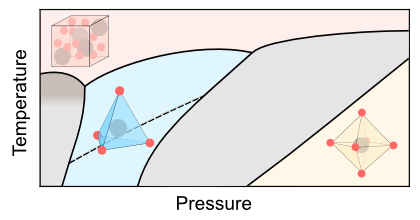
Understanding phase stability and phase transformations is central to predicting material behavior under varying thermodynamic conditions. One of the earliest and most influential applications of density functional theory in materials science has been the prediction of pressure-induced phase transitions at 0 K. Extending these calculations to finite temperatures, however, requires accounting for thermal, quantum, and anharmonic contributions to the free energy, often at significant computational cost. In this work, we present a general and efficient framework for calculating low-temperature phase boundaries by combining the Clausius-Clapeyron equation with the quasi-harmonic approximation. This methodology requires a minimal number of calculations, while naturally incorporating internal degrees of freedom and allowing for the inclusion of quantum and low-order anharmonic effects. We illustrate the accuracy and efficiency of the approach by constructing the phase diagram of silica in the pressure range from -2 to 12 GPa and temperatures up to 1750 K. To this end, we employ both density functional theory and a machine-learned interatomic potential, enabling well-converged free energy estimates and a rigorous comparison between first-principles and data-driven models.