Thermal Stabilization of Defect Charge States and Finite-Temperature Charge Transition Levels
T. Hainer,
E. Berger,
E. Berger,
O. Hildeberg,
P. Erhart,
and
J. Wiktor
arXiv:2512.15463
doi: 10.48550/arXiv.2512.15463
zenodo: 17939378
(associated data)
Download PDF

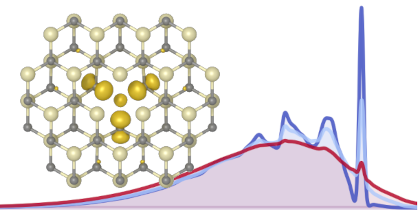
Point defects introduce localized electronic states that critically affect carrier trapping, recombination, and transport in functional materials. The associated charge transition levels (CTLs) can depend on temperature, requiring accurate treatment of vibrational and electronic free-energy contributions. In this work, we use machine-learned interatomic potentials to efficiently compute temperature-dependent CTLs for vacancies in MgO, LiF, and CsSnBr3. Using thermodynamic integration, we quantify free-energy differences between charge states and calculate the vibrational entropy contributions at finite temperatures. We find that CTLs shift with temperature in MgO, LiF and CsSnBr3 from both entropy and electronic contributions. Notably, in CsSnBr3 a neutral charge state becomes thermodynamically stable above 60 K, introducing a temperature-dependent Fermi-level window absent at 0 K. We show that the widely used static, zero-kelvin defect formalism can miss both quantitative CTL shifts and the qualitative emergence of new stable charge states.