Compositional Disorder Controls Bulk Ion Diffusion in Mixed-Ion Halide Perovskites
B. M. Gallant,
P. Deswal,
S. Banerjee,
E. Fransson,
J. Hammerton,
M. Walters,
J. Deakin,
W. Burston,
P. Erhart,
J. Wiktor,
and
D. J. Kubicki
ChemRxiv, 15008055
(2026)
doi: 10.26434/chemrxiv.15008055
Download PDF
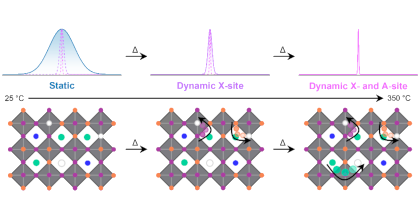
Compositional mixing enables bandgap and phase-stability engineering in metal halide perovskites, but its effect on intrinsic ion mobility is obscured by surfaces, interfaces, and concurrent structural dynamics. Here, variable-temperature magic-angle-spinning NMR combined with machine-learning-accelerated molecular dynamics separates soft-phonon relaxation from vacancy-mediated diffusion across a Cs/Rb–Br/I composition matrix. Br/I mixing markedly accelerates bulk halide transport, whereas combined Br/I and Cs/Rb substitution produces a second, slower regime assigned to A-site cation diffusion. Linewidth and relaxation analyses yield consistent hopping barriers and an Arrhenius-extrapolated room-temperature bulk halide diffusivity of order 10−11 cm2s−1, below values commonly inferred from electrical measurements of thin films. Simulations at fixed vacancy concentration reproduce the species-dependent mobility trends and indicate that static local distortions broaden the distribution of migration environments, creating locally accessible pathways for ion motion. These results distinguish intrinsic mobility per available defect from macroscopic ion redistribution, which additionally depends on defect abundance, interfaces, and thermodynamic or photoinduced driving forces. Enhanced per-defect mobility therefore need not imply rapid operational phase segregation, providing a framework for connecting compositional disorder with processing and stability in multicomponent ionic semiconductors.